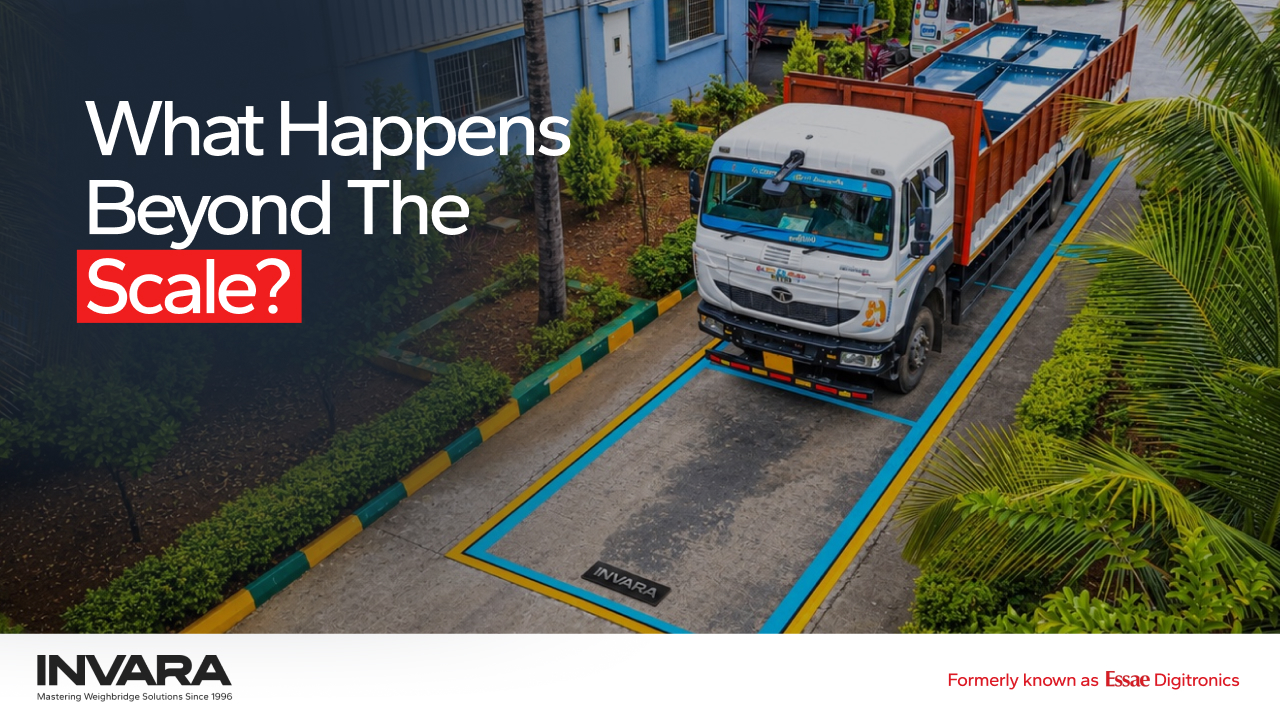
Your Weighbridge Is Accurate. But Is Your Material Movement Under Control?
- October 2026
- Your Weighbridge Is Accurate. But Is Your Material Movement Under Control?
An accurate weighbridge is important.
But accurate weight alone does not always mean your material movement is fully under control.
A truck may be weighed correctly, yet issues can still arise from manual data entry, incorrect vehicle details, wrong tare weight, duplicate transactions, or disconnected processes.
That is why businesses should look at weighing as more than a machine at the gate.
It is a control point for material, inventory, and money.
For industries handling large volumes of raw materials or finished goods, even small process gaps can become significant when repeated across hundreds of truck movements.
5 Areas Every Weighing Operation Should Review
1. Measurement
The first question is simple:
Can you trust the weight?
The weighbridge platform, load cells, indicator, calibration and mechanical condition all play an important role in dependable weighing.
But this is only the starting point.
A correct weight linked to the wrong vehicle, material or supplier can still create an incorrect business record.
So accuracy should not stop at measurement. It should continue throughout the complete weighing transaction.
2. Vehicle and Material Identification
How much information does your operator enter manually?
Vehicle number. Material. Supplier. Customer. Order number.
Every manual entry creates another opportunity for error.
A small mistake at the gate may look harmless, but it can become a much bigger problem when the transaction needs to be checked later.
For busy plants, mines, warehouses, and logistics operations, the goal should be clear:
Reduce unnecessary manual intervention and improve traceability.
The better a transaction is identified at the beginning, the easier it becomes to track and verify later.
3. Tare Weight Control
Gross vehicle weight often gets most of the attention.
But in a weighbridge transaction, the actual material weight depends on both gross and tare weight.
Net Material Weight = Gross Vehicle Weight − Tare Vehicle Weight
Consider a simple example.
If the tare weight varies by 100 kg across 50 truck transactions, the cumulative difference could reach 5 tonnes.
Not every tare variation indicates a problem. Fuel level, driver presence, vehicle condition and other operating factors can cause genuine changes.
The important question is:
Can your team quickly identify when a tare variation is unusual?
Small differences may not look significant individually, but repeated differences can affect reconciliation, inventory, and material accounting.
4. Transaction Control
Now look beyond the weight itself.
Ask your team:
- Who can change a completed weighment?
- Can a transaction be duplicated?
- Can a required step be bypassed?
- Can you see when a record was changed?
- Can you trace the transaction back to the correct vehicle and material?
A good weighing process should provide more than a printed ticket.
It should create accountability and traceability.
For businesses handling steel, cement, minerals, grain, aggregates, scrap or other bulk materials, this becomes an important part of maintaining better material control.
5. Data Integration
In many facilities, weighing data still sits separately from ERP, inventory, dispatch or procurement systems.
Then someone enters the same information again.
That creates extra work and another opportunity for mismatch.
This is where a broader weighing solution becomes valuable.
When weighing data connects with other business processes, information can move more efficiently across operations while reducing repeated manual work.
A useful principle is:
One physical movement. One authorised transaction. One traceable record.
When teams have better access to connected weighing information, they can spend less time reconciling records and more time acting on what the data tells them.
A Quick Health Check for Your Weighing Process
Ask these five questions:
- Can we trace every weighment to the correct vehicle and material?
- How much information is still entered manually?
- Can we quickly identify unusual tare changes?
- Do we know who changed a transaction and when?
- Does weighing data connect with the rest of our business processes?
If several answers begin with we need to check, there may be an opportunity to strengthen the process.
Weighing Is Becoming More Than Measurement
The role of industrial weighing is changing.
Businesses no longer need only an accurate number on a display.
They also need:
Accuracy. Traceability. Visibility. Control.
A reliable weighbridge gives you the weight.
A well-designed weighing solutions goes further by helping you improve traceability, reduce process gaps, and maintain better control over material movement.
That means the real value of weighing is not only in the number captured.
It is also in the confidence you have in every transaction connected to that number.
At INVARA Digitronics, we believe weighing should support better control across the complete material movement process.
Because every vehicle crossing your weighbridge represents more than weight.
It represents material, inventory, and a business transaction that needs to be trusted.
A Question for Your Team
Pick one truck that passed through your facility three months ago.
How quickly can you reconstruct its complete weighing transaction today?
The answer may tell you more about your weighing process than the number on the display.
INVARA Mastering Weighbridge Solution Since 1996
#INVARADigitronics #IndustrialWeighing #Weighbridge #WeighingSolutions #MaterialManagement #Manufacturing #OperationalExcellence